
Molecular Insights into Water Solubility in Fluid Carbon Dioxide for CCS Applications
A new paper from our group has been published.
In CCS (CO2 capture and storage), CO2 recovered from industrial sources is transported by pipeline and stored underground. Even a small amount of water mixed into the CO2 can cause trouble: if water precipitates, ice-like CO2 hydrate may form and block the pipe, or carbonated water may corrode the infrastructure. How much water can fluid CO2 hold under a given temperature and pressure? The relevant conditions span gas, liquid, and supercritical states, and are hard to cover by experiment alone.
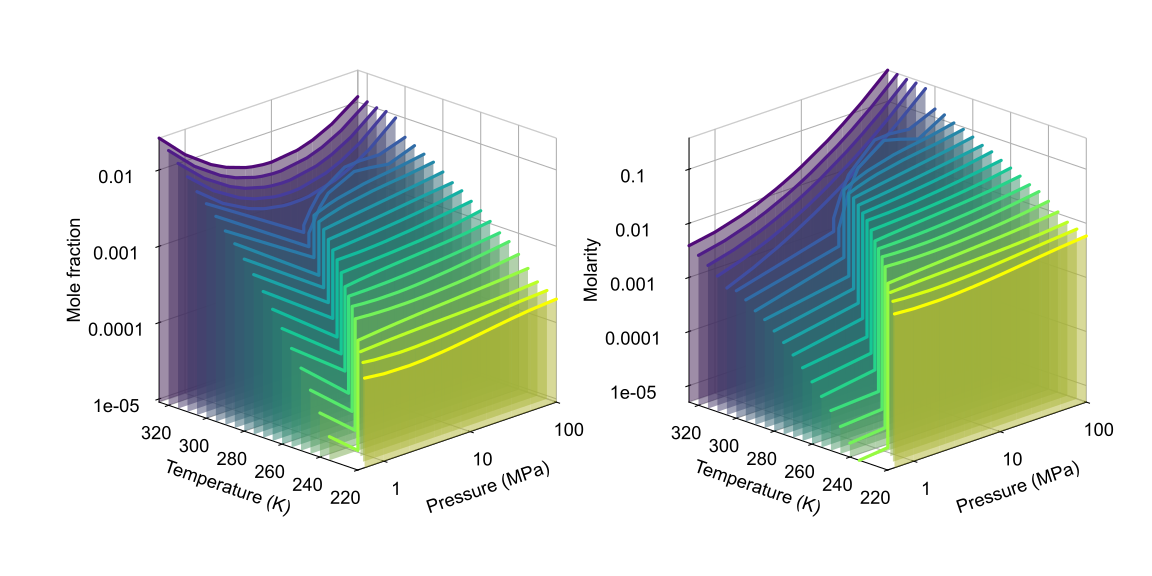
In this work, we estimate the solubility of water in fluid CO2 over a wide range of temperatures and pressures relevant to CO2 transport and storage, by calculating the chemical potential of water from intermolecular interactions. The obtained solubilities agree well with experimental measurements and existing model calculations. We also confirm that, under conditions where hydrate forms, the solubility is further reduced relative to the case of coexistence with a metastable aqueous solution without hydrate.
An interesting point concerns the unit used to express solubility. The figure above shows the calculated water solubility as a function of temperature and pressure: the left panel uses the conventional mole fraction, and the right panel uses molarity (amount of water per unit volume). In mole fraction, compression of gaseous CO2 appears to lower the solubility—an apparently strange behavior. This is merely an artifact of the growing number of CO2 molecules in the denominator upon compression, and it disappears when solubility is expressed in molarity. The molarity-based representation not only makes the temperature and pressure dependence easier to understand in terms of intermolecular interactions, but also correlates more naturally with the driving force for water-induced corrosion.
A change in the unit of measure can clarify the picture—an example of how a statistical-mechanical viewpoint feeds into the fundamental data needed to prevent hydrate blockage and corrosion in CO2 transport and storage. Reading this together with our previous paper on the phase behaviour of liquid CO2 with hydrate may help to see the broader context.
- H. Tanaka, M. Matsumoto, T. Yagasaki, M. Takeuchi, and T. Kono, “Molecular Insights into Water Solubility in Fluid Carbon Dioxide for CCS Applications,” Energy & Fuels, 40, 23427–23435 (2026).
- DOI:10.1021/acs.energyfuels.6c04094